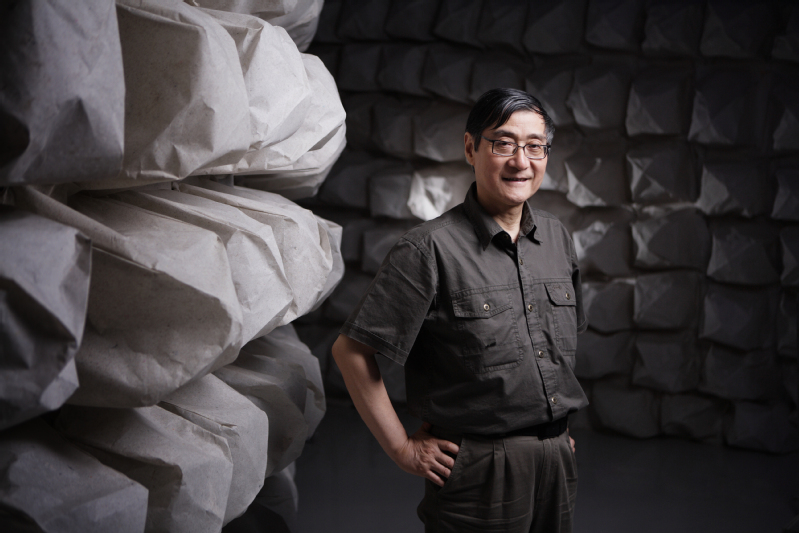
In 1991, he was honored as an intellectual with special contributions. In 1997, he was recognized as a national-level young and middle-aged expert with outstanding contributions and is an expert enjoying special government allowances from the State Council. He served as a member of the 9th, 10th, and 11th National Committees of the Chinese People's Political Consultative Conference, vice chairman of the China Artists Association, and the chief planner and designer for the exhibition design of the China Pavilion at the Shanghai World Expo. Currently, he is the architectural art director of the Architectural Design and Research Institute of the Chinese Academy of Sciences, an advisory member of the Urban Design Professional Committee of the Science and Technology Committee of the Ministry of Housing and Urban-Rural Development, and the inaugural dean of the Fudan University Institute of Arts. He holds honorary doctorates from the San Francisco Art Institute (USA), the University of Glasgow (UK), the Maryland Institute College of Art (USA), and Emily Carr University of Art + Design (Canada). He is a professor and doctoral supervisor at the Central Academy of Fine Arts, the School of Philosophy at Fudan University, and Macau University of Science and Technology. Additionally, he is a member of the Central Institute for Culture and History.
Since the 1980s, Pan Gongkai's academic proposition of complementary coexistence and bidirectional in-depth exploration between Chinese and Western art systems has exerted considerable influence in China's art community. His installation work Fusion(《融》)was exhibited at the 54th Venice Biennale, while his ink paintings Wind and Lotus(《风荷图》)and Snow Lotus(《雪莲图》)were showcased at the 56th Venice Biennale. Pan Gongkai's ink paintings are characterized by their immense scale, majestic presence, elegant style, and profound artistic conception. They retain the free, profound, spontaneous, and exquisite brushwork of traditional literati painting while seamlessly integrating and interacting with contemporary cultural contexts, embodying a unique contemporary aesthetic sensibility and artistic style tension. His works represent a valuable exploration and possibility for the contemporary development and transformation of freehand brushwork Chinese painting. He has held solo exhibitions at the world's most important art museums in London, New York, San Francisco, Seattle, San Diego, Michigan, Vancouver, Paris, Venice, Karlsruhe, Prague, Tokyo, Hong Kong, Macau, Taipei, Beijing, Shanghai, Guangzhou, Chengdu, Xi'an, Hangzhou, Jinan, Changsha, and other cities, receiving widespread acclaim. His works have been collected by major museums, art institutions, and private collectors.
In addition to his outstanding achievements in contemporary art education and artistic creation, Pan Gongkai has also made substantial contributions to art theory, with insightful and unique viewpoints. He is the author of numerous works, including A History of Chinese Painting(《中国绘画史》), Limitation and Expansion(《限制与拓展》), Analysis of Pan Tianshou's Painting Techniques(《潘天寿绘画技法解析》), A Critical Biography of Pan Tianshou(《潘天寿评传》), The Path of Chinese Modern Art(《中国现代美术之路》), Noble Spirit and Sturdy Bones: The Art of Pan Tianshou's Painting(《高风峻骨——潘天寿绘画艺术》), Brush and Ink in Chinese Painting(《中国笔墨》), Generation and Construction(《生成与营构》), Imaginary Domain City(《象域城市》), among others. He has also served as the editor-in-chief of large-scale picture book series such as Modern Design Series(《现代设计大系》), Pan Tianshou's Calligraphy and Painting Collection(《潘天寿书画集》), 60 Years of Chinese Art(《中国美术60年》)and The Complete Works of Pan Tianshou(《潘天寿全集》), which have had a broad impact in the humanities and social sciences. His significant research project The Path of Chinese Modern Art(《中国现代美术之路》), which he pursued for a decade, was awarded the highest national prize for philosophical and social science research achievements in 2015. The book proposes an original theoretical framework in the field of modernity studies in post-developed countries. The Korean edition was published by Chaemyeong Publishing in South Korea in 2019, the Japanese edition by Sayusha in Japan in 2020, and it is currently being translated into major world languages.
With comprehensive scholarly attainment, extensive knowledge, and profound research, Pan Gongkai has made remarkable achievements in five major fields: Chinese painting, art theory, contemporary art, architectural design, and art education. He is truly one of the most unique artist cases in China's contemporary art scene.
In 1991, he was honored as an intellectual with special contributions. In 1997, he was recognized as a national-level young and middle-aged expert with outstanding contributions and is an expert enjoying special government allowances from the State Council. He served as a member of the 9th, 10th, and 11th National Committees of the Chinese People's Political Consultative Conference, vice chairman of the China Artists Association, and the chief planner and designer for the exhibition design of the China Pavilion at the Shanghai World Expo. Currently, he is the architectural art director of the Architectural Design and Research Institute of the Chinese Academy of Sciences, an advisory member of the Urban Design Professional Committee of the Science and Technology Committee of the Ministry of Housing and Urban-Rural Development, and the inaugural dean of the Fudan University Institute of Arts. He holds honorary doctorates from the San Francisco Art Institute (USA), the University of Glasgow (UK), the Maryland Institute College of Art (USA), and Emily Carr University of Art + Design (Canada). He is a professor and doctoral supervisor at the Central Academy of Fine Arts, the School of Philosophy at Fudan University, and Macau University of Science and Technology. Additionally, he is a member of the Central Institute for Culture and History.

Contact us
Email:philosophy@fudan.edu.cn
Telephone: 021-65642731
Post Code: 200433
Address: School of Philosophy,Fudan University, No. 220 Handan Road,
Shanghai, China (Room 2308,West Main Building, Guanghua Building)


Copyright©2024 School of Philosophy, Fudan University. All Rights Reserved.
