International Congress of Mathematicians
01
Held every four years, the International Congress of Mathematicians (ICM) is a global academic conference organized by the International Mathematical Union (IMU). The congress aims to promote high-level academic exchange, with world-renowned mathematical awards such as the Fields Medal presented during the opening ceremony. Throughout the event, renowned mathematicians engaged in cutting-edge research worldwide will report on major scientific achievements in their respective fields.
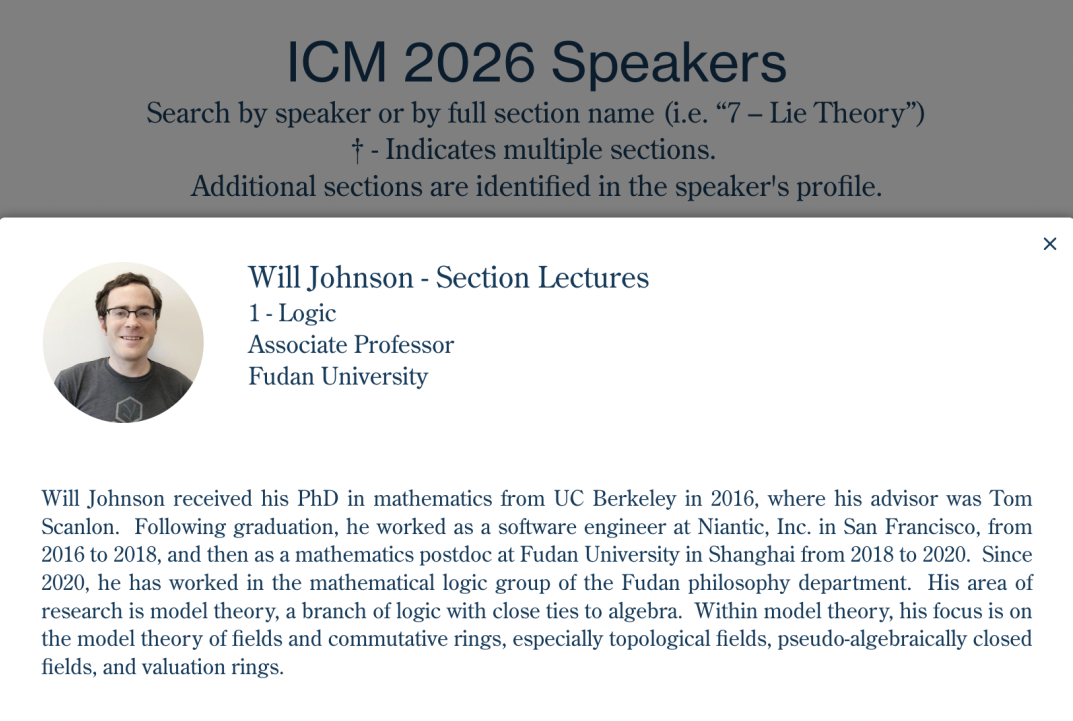
The 2026 International Congress of Mathematicians will be held in Philadelphia, Pennsylvania, from July 23 to 30, 2026. Recently, the ICM official website announced the list of speakers for the 2026 Congress. Will Johnson, a young teacher from our institute, has been selected to deliver an invited talk during next year's conference.
Teacher Profile
02

Will Johnson
Will Johnson earned his bachelor's degree in Mathematics and Computer Science from the University of Washington in 2011 and his Ph.D. in Mathematics from the University of California, Berkeley. He joined the School of Mathematical Sciences at Fudan University as a postdoctoral researcher in October 2018 and formally joined the School of Philosophy at Fudan University in 2022. Will Johnson specializes in model theory, a branch of mathematics that uses tools from mathematical logic to explore mathematical structures in algebra and combinatorics. His primary research areas include: - Dependent fields and rings - Field arithmetic and étale-open topology - Tame topology and definable groups He has published numerous papers in international journals such as the Journal of Mathematical Logic, Journal of the European Mathematical Society, Annals of Pure and Applied Logic, Mathematische Nachrichten, and Mathematical Logic Quarterly. In teaching, he has long offered undergraduate and graduate courses such as “Introduction to Model Theory” and “Advanced Model Theory,” mentoring numerous students at both levels and receiving widespread acclaim from his students.
Student Evaluations
Yang Yang, Master's Student in Logic, Class of 2022:
During my graduate studies at Fudan University, my research primarily focused on definable topologies over NIP fields. The findings in my thesis built upon Professor Will's work concerning dp-finite fields and the Shelah Conjecture. Throughout this process, Professor Will provided invaluable guidance as my advisor. First, he meticulously designed coursework and seminar content, enabling students like me—without a mathematics background—to swiftly acquire the necessary mathematical foundations for studying certain model theory research areas. Second, he demonstrated exceptional dedication to his students, scheduling weekly one-on-one discussions and generously sharing his latest research developments and insights during academic exchanges. He consistently provided thorough responses to our questions, offering valuable reference materials and sometimes even compiling comprehensive proofs into documents for our review. Moreover, he encourages us to proactively discover new problems, attend academic conferences to explore diverse research directions, and cultivate the ability to identify and deepen novel ideas during this process. Under Professor Will's guidance, I progressed from lacking foundational knowledge to appreciating the beauty of model theory, ultimately deciding to pursue advanced studies. His influence on me has been profound. This August, I will embark on a Ph.D. program in mathematics at Carnegie Mellon University.
Dear Jing Qihang, Class of 2019 Master's Student:
Will left the deepest impression on me primarily in three areas: course instruction, academic guidance, and scholarly presentations. Regarding course instruction, Will's “Introduction to Model Theory” course used abstract algebraic structures as teaching examples, progressively elucidating the core concepts of model theory. The course introduced foundational first-order logic and advanced through strongly minimal models, presenting a comprehensive framework of model theory fundamentals while leveraging the intuitive nature of algebraic structures to enhance understanding of abstract concepts. Notably, he conducted all lectures using chalkboard writing. I believe this traditional teaching method is more suitable for mathematics courses than slides. Additionally, the course utilized a textbook authored by Will himself. This textbook features a coherent and comprehensive knowledge system, providing concise introductions to important model-theoretic structures such as ACF theory. I consider it one of the best introductory texts on model theory. In the “Advanced Model Theory” course, Will continuously adapts the teaching content based on the learning progress of the previous cohort. Relevant course handouts are provided after each session. This greatly facilitates student review and allows them to focus more intently on the lecture without worrying about note-taking. Will also places significant emphasis on student interaction, often incorporating classroom questions into the grading criteria. Furthermore, I served as a teaching assistant for Will's class. During my time as a TA, Will meticulously guided me on how to grade assignments and corrected any misconceptions I had about the material. In summary, Will's Model Theory course is an essential component of logical studies. Its comprehensive syllabus, rigorous yet engaging lectures, and consistent student interaction set a benchmark for classroom excellence. Will's academic presentations mirror his textbook approach: introducing foundational concepts through accessible explanations, then advancing content by integrating theorems with practical examples. In terms of guidance, Will is exceptionally dedicated. He schedules one-on-one sessions to review my progress and address my questions. He also organizes reading groups outside class to deepen our understanding of model theory. Furthermore, regarding specific research directions, Will identifies potential breakthrough points and provides relevant reference materials.
Gao Chichuan, Class of 2021, Philosophy of Science and Logic Major:
During my undergraduate studies, I took nearly every logic course offered by the Philosophy Department (the four core logic courses and their advanced counterparts). Will was my professor for the Model Theory course, and he also served as my academic year paper and graduation thesis advisor. I am delighted to share how Will has supported me. He approaches teaching with exceptional dedication, consistently providing several pages of review questions and clearly defined exam scope before assessments. When I suggested incorporating challenging problems beyond routine assignments, he readily agreed and introduced supplementary exercises in the next class—all meticulously crafted by him based on course content. When guiding my thesis, he proactively arranged weekly one-hour meetings to discuss challenges I encountered in writing. Drawing on his deep and solid mathematical knowledge, he explained concepts clearly and accessibly. Often, when I struggled to articulate my questions, he would draw on his experience to explain common difficulties in understanding. Currently, I plan to delve deeper into model theory, largely because Will demonstrated its power and beauty through his coursework and personal example.
The Mathematical Logic Team of the Department of Philosophy at Fudan University
03
The Mathematical Logic Team at Fudan University, where Will Johnson is based, serves as a vital force in the teaching and research of the School of Philosophy. It primarily operates under the Logic Teaching and Research Section. In 2000, Hao Zhaokuan joined Fudan, commencing his teaching of modern mathematical logic courses and related research. Subsequently, Yang Ruizhi, Yao Ningyuan, and Will Johnson joined the faculty, formally establishing the mathematical logic teaching and research team.
In research, team members actively pursue studies in model theory and the philosophy of mathematics. They have published numerous academic papers in leading journals such as Philosophical Studies, Journal of Elementary Mathematics, Advances in Mathematics, JLMS, JSL, JML, APAL, FM, and NDJFL. They have presented at numerous high-level international conferences and undertaken research projects including National Natural Science Foundation of China (NSFC) General and Young Scientist Programs, National Social Science Fund General and Young Scientist Programs, and Major Projects of Key Research Bases for Humanities and Social Sciences under the Ministry of Education.
In teaching, the team has played a vital role in cultivating undergraduate and graduate students at the School of Philosophy. It actively contributes to the university-wide undergraduate education through the general education platform and the Mathematical Logic Program. In 2015, the School of Philosophy introduced a new undergraduate major in Philosophy (Philosophy of Science and Logic). As a core component of this program, mathematical logic underwent further systematization and standardization in its curriculum design. The specialized courses now encompass all major areas of modern mathematical logic—including set theory, computability theory, model theory, and proof theory—collectively known as the Four Theories of Mathematical Logic.
In 2018, as Fudan University advanced its “2+X” undergraduate education reform initiative, the team responded proactively. With support from the Academic Affairs Office and relevant schools, they began exploring and developing an interdisciplinary program in mathematical logic, establishing Fudan's first cross-disciplinary program. The Mathematical Logic Program has attracted approximately 250 student registrations to date. The project received the Second Prize in the 2022 Shanghai Higher Education Outstanding Teaching Achievement Awards. To further enhance the cultivation of high-level talent in mathematical logic at Fudan and nationwide, and to strengthen the influence of Fudan University's logic discipline, the team launched the Fudan University Mathematical Logic Summer School in 2018. Now in its eighth year, the program has established a strong brand presence, with cumulative registrations exceeding 1,000 student-years. Alongside routine teaching, the team actively engages in textbook development. Since 2014, it has published the Logic and Metaphysics Textbook Series, with six volumes released to date. The series has gained significant academic recognition and is widely adopted as course material. The first two volumes received the Second Prize for Outstanding College Textbooks in Shanghai, while the entire series was honored with the First Prize in Fudan University's inaugural Textbook Development Awards.