
School of Philosophy, Fudan University
July 27, 2025 20:02 Shanghai
VOL.4497
July 26, 2025, Shanghai — At the Galaxy Enlightenment(星河启智) · Scientific Intelligence Open Cooperation Forum during the 2025 World Artificial Intelligence Conference and High-Level Conference on Global AI Governance (WAIC 2025), Academician Jin Li, President of Fudan University; Academician Xue Qikun, President of Southern University of Science and Technology; Academician Ge Junbo, Director of the Department of Cardiology at Fudan University Affiliated Zhongshan Hospital; Qu Wei, Deputy Director of the Shanghai Municipal Science and Technology Commission; Professor Jiang Yugang, Vice President of Fudan University, and Professor Wang Guoyu, Dean of the Institute of Science Ethics and Human Future at Fudan University, jointly unveiled “Mirror”—the world's first AI agent system specifically designed for ethical review in science and technology.

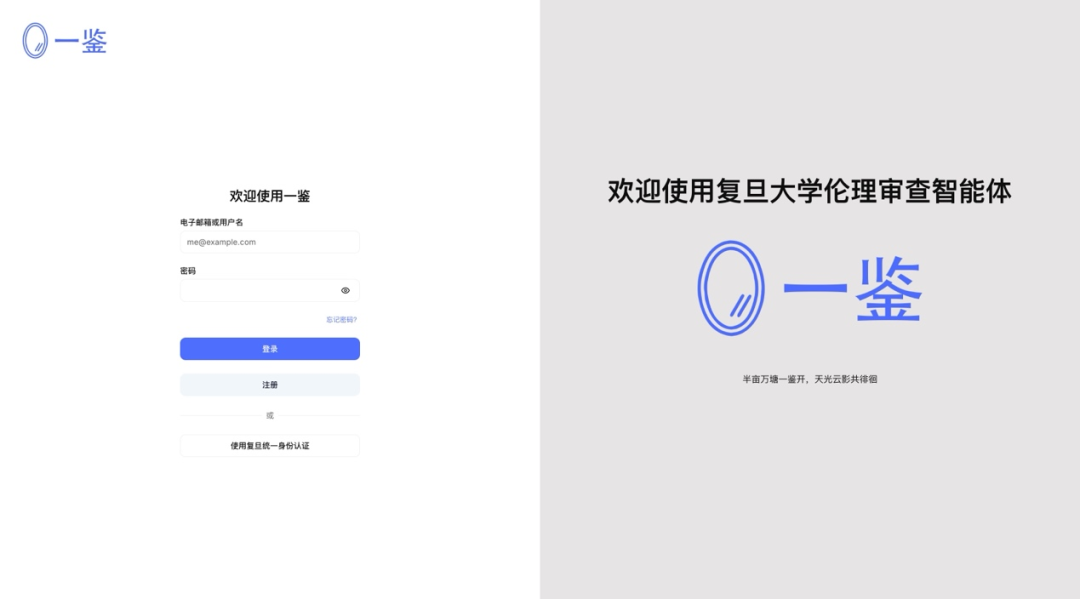
Half an acre of square pond, a mirror unfolds, Sky's light and clouds' shadows linger and sway. “One Mirror” (English name: Mirror) symbolizes using technology's “mirror” to discern potential risks, uphold ethical boundaries for technological innovation, and safeguard human dignity.
“Mirror” was jointly developed by Fudan University's Institute for Science Ethics and Human Future, the Trustworthy Embodied Intelligence Research Institute, in collaboration with multiple departments and research institutions including the School of Philosophy, School of Life Sciences, and Zhongshan Hospital. It received strong support from Fudan University's Institute of Science and Technology and the Shanghai Artificial Intelligence Laboratory.
Accelerating Technological Innovation, Prioritizing Ethical Governance
In 2021, General Secretary Xi Jinping emphasized at the Joint Conference of Academicians of the Chinese Academy of Sciences and the Chinese Academy of Engineering and the National Congress of Science and Technology that “science and technology are powerful tools for development, but they can also become sources of risk.” He called for forward-looking assessments of rule conflicts, social risks, and ethical challenges arising from technological advancement, and for improving laws, regulations, ethical review rules, and regulatory frameworks.
As we enter the era of “AI for Science,” artificial intelligence is accelerating scientific innovation and knowledge breakthroughs while simultaneously raising the bar for ethical governance. Ethical review serves as a critical safeguard for responsible innovation. China's ethics committees have expanded from the medical field to encompass all scientific research, gradually establishing a multi-tiered ethical review and reporting system spanning institutional ethics committees, regional (provincial/municipal) ethics committees, and the National Ethics Committee. In recent years, multiple documents—including the Ethical Review Measures for Biomedical Research Involving Human Subjects, Opinions on Strengthening Science and Technology Ethics Governance, and the Science and Technology Ethics Review Measures (Trial)—have been successively issued, establishing the fundamental principle of “ethics first.” The top-level design, management standards, and capacity building of ethics committees are continuously improving and upgrading, propelling China toward a new phase of science and technology ethics governance.
As the nation places increasing emphasis on science and technology ethics governance, the volume of ethics review tasks has surged, necessitating further improvements in both efficiency and quality. Whether frontier technologies like artificial intelligence can contribute to ethics governance, thereby fostering a collaborative advancement of “science and technology alongside ethics governance,” has emerged as a new topic worthy of exploration.
“Mirror”: The world's first ethical review AI system

The Institute of Science and Technology Ethics and Human Future at Fudan University, in collaboration with the Trustworthy Embodied Intelligence Research Institute and multiple academic departments and research institutions, has pioneered the world's first ethical review agent,“Mirror.” This initiative provides China's science and technology ethics governance with an efficient, standardized, and trustworthy intelligent support system.
The core of Mirror is a specialized large model fine-tuned on high-quality ethical review data, deeply mastering various ethical norms and professional knowledge. Building upon this foundation, Mirror integrates four core modules: a rule updater, a rule graph builder, a rule matcher, and a rule reviewer. The system automatically crawls and extracts the latest policies and regulations on a regular basis, constructing a layered, domain-specific ethical rules knowledge graph. It efficiently and accurately matches relevant rules to project materials under review. Leveraging retrieval-enhanced generation technology, Mirror intelligently segments document content, analyzes compliance, automatically labels ethical risk levels, provides detailed explanations with source text references, and ultimately generates professional ethical review reports, delivering robust decision support for ethics experts.
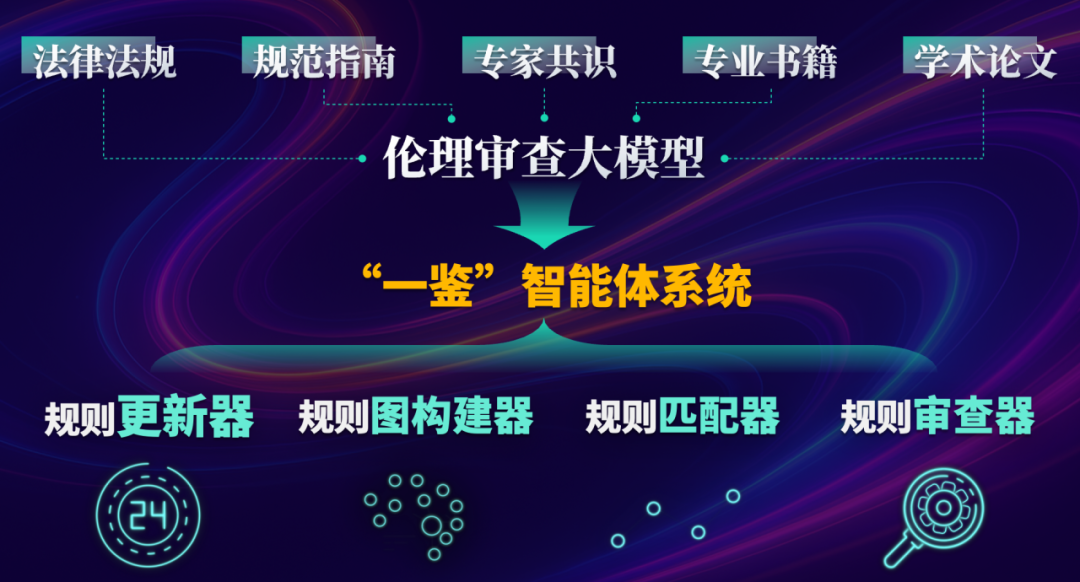
Despite having only 8 billion parameters, the specialized ethical review large model behind “Mirror” has surpassed mainstream domestic open-source models and internationally advanced closed-source models in terms of review accuracy and professionalism. Currently, the “Mirror” system has been piloted at Fudan University and its affiliated Zhongshan Hospital, receiving high praise from ethics experts and establishing itself as a trusted intelligent assistant for ethical review.
The entire development process of the “Mirror” AI agent strictly adheres to national and Fudan University ethical standards and data protection requirements. It supports localized private deployment, ensuring data remains offline, within the domain, and is not retained, thereby comprehensively safeguarding data security and privacy compliance.
Continuously evolving to build a global foundation for intelligent technology ethics
Looking ahead, the project team will continuously enhance Mirror's cross-domain generalization capabilities and dynamic responsiveness. This will drive the deep application of AI-powered ethical review in high-risk ethical fields such as life sciences, clinical medicine, biopharmaceuticals, and artificial intelligence. Actively participating in global technology governance, the team will contribute Chinese wisdom to help build a more precise, efficient, and intelligent global technology ethics governance system. This effort aims to shape a culture where technology serves humanity for the greater good.
A New Exploration in New Liberal Arts Development
“Mirror” also represents an initial achievement in Fudan University's New Liberal Arts Initiative, serving as an innovative practice of AI-empowered humanities. The “Mirror” team brings together leading scholars from philosophy, computer science, medicine, life sciences, and other fields. Committed to building a globally leading multidisciplinary innovation platform for AI ethics and governance, the team strives to develop a theoretical framework, policy structure, and technical standards with Chinese characteristics and international influence, thereby leading the academic frontiers and practical paradigms of AI ethics research. Moving forward, the team will continue exploring interdisciplinary development in science and technology ethics and cultivating composite talents. It will strive to advance the new liberal arts, construct China's disciplinary, academic, and discursive systems for science and technology ethics, and establish a robust ethical foundation for global technological innovation.