
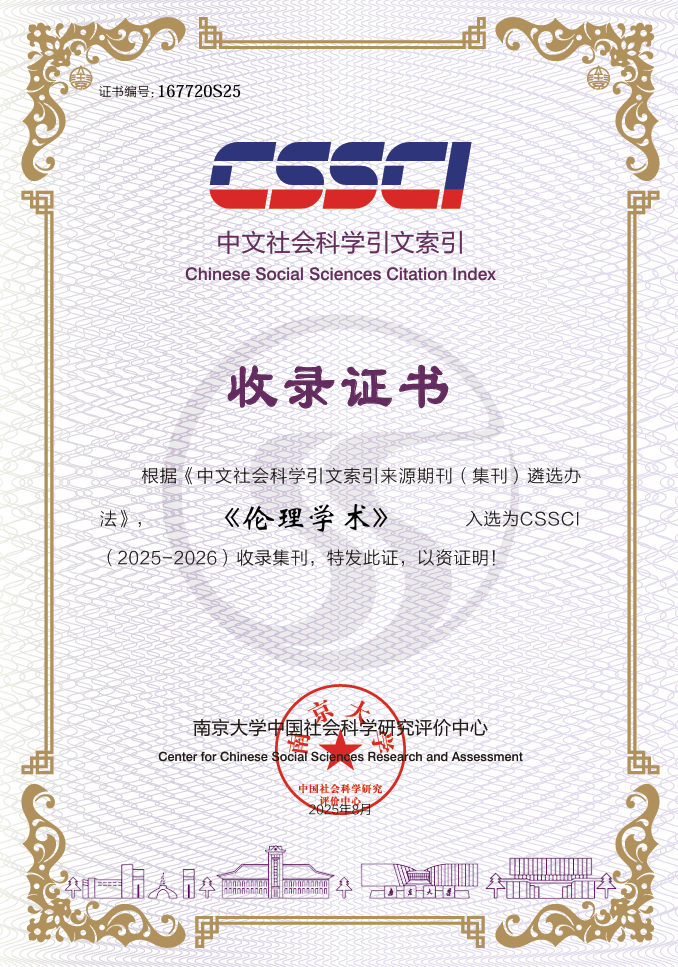
In August 2025, Academia Ethica — a journal of practical philosophy jointly sponsored by the School of Philosophy at Fudan University and the Shanghai Educational Publishing House — was selected for inclusion in the CSSCI (Chinese Social Sciences Citation Index) for the 2025–2026 period.
Journal Information
Overview:
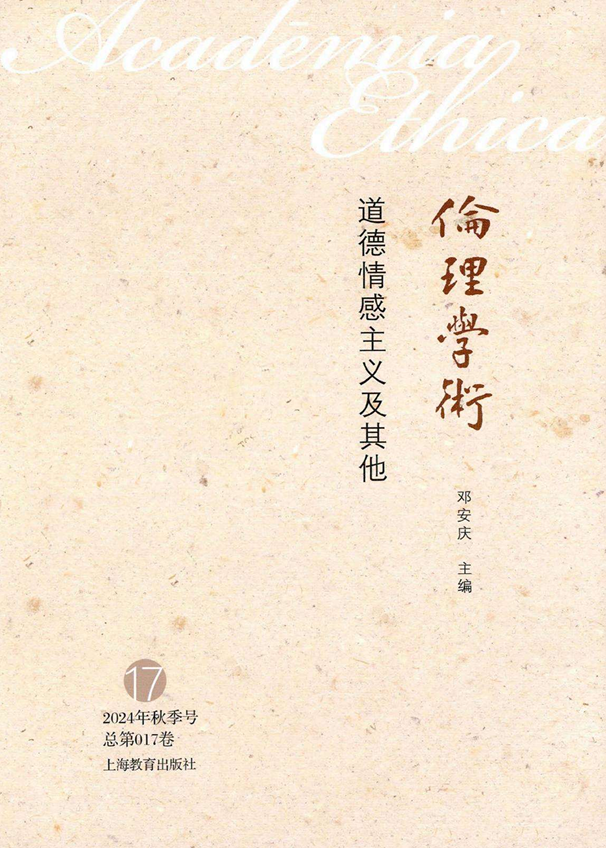
Founded in 2016, Academia Ethica is a scholarly publication in practical philosophy jointly organized by the School of Philosophy Fudan University and the Shanghai Educational Publishing House. It adopts a book-as-journal publishing model, releasing two issues each year, in spring and autumn. Each issue centers on one or two philosophical themes, fostering in-depth rational discussion and academic debate. Its defining feature lies in maintaining the philosophical rigor of ethics, eschewing all forms of non-academic noise, and returning to ‘ethics as a practical philosophy’, thereby exploring the crises and problems it faces in both its historical and contemporary contexts on a scholarly basis.
Editor-in-Chief: Deng Anqing
Partner Publisher: Shanghai Educational Publishing House
Submission Email: ethica@163.com
WeChat Official Account: 伦理学术
02 Introduction of the Chief Editor

Deng Anqing, is a Distinguished Professor at Fudan University and doctoral supervisor at the School of Philosophy Fudan University. He also serves as Director of the Institute for Western Ethics at the Center for Ethics and Moral Construction of Education at Renmin University of China, a Key Research Institute of Humanities and Social Sciences at Universities; Vice President of the China Association For Ethical Studies; Executive Deputy Chief Editor of The Collected Works of Hegel(《黑格尔著作集》) (20-volume edition of theoretical works(20卷理论著作版)); and Chief Editor of the Academia Ethica series.
His main research areas include German philosophy, ethics, and the history of Western moral philosophy. He has published more than ten monographs, among them Schelling (1995, Taipei), Schleiermacher (1997, Taipei), Schopenhauer (1999, Taipei), and Enlightenment Ethics and Public Morality in Modern Society: A Reexamination of the Moral Enterprise in German Classical Philosophy(《启蒙伦理与现代社会的公序良俗--德国古典哲学的道德事业之重审》)(People’s Publishing House, 2013). He is currently working on a ten-volume series titled A General History of Western Moral Philosophy(《西方道德哲学通史研究》), of which the introductory volume, The Ethics of Deontic Actualism(《道义实存论伦理学》), has recently been published by the Commercial Press.
He has translated ten classic works of Western philosophy, including Aristotle’s Nicomachean Ethics (annotated and with an introduction, 2013), Schelling’s On the Essence of Human Freedom (2008), and Hegel’s Elements of the Philosophy of Right (2016). He has published around 190 academic papers in leading domestic and international journals.
02. Preface
Integrating Chinese Ethical Discourse into the Civilizational Process of the Modern World
By Deng Anqing
The most severe crisis confronting today’s world is the gradual disintegration of the global order. The United States, long the leader of the Western world, finds its position increasingly precarious; hope, once placed on the European Union as a counterbalancing power, has largely faded as the EU struggles to sustain itself. Meanwhile, China’s rise as a new global power has not been accompanied by a kind of philosophy capable of leading the World Spirit. Consequently, rather than being embraced by the world, China is often perceived as a source of instability and anxiety. The world thus stands amid crises on all fronts. Civilization falters in its progress, while tendencies toward barbarization become ever more apparent.
Hence, what the world most urgently requires today is ethical scholarship, for the first vocation of ethics, as a love of wisdom (philo-sophia), is to seek a way for all humankind to coexist together. Philosophy once promised that its thinking would safeguard the place of Being. Yet when philosophy came to place the meaning of ‘to be’ as its supreme metaphysical concern, it tore ontology apart from ethics. Ethics as moral philosophy, was reduced to an analysis of moral language and a justification of normative reasons for action, thereby forgetting its own basis in ontology. Even thinkers such as Heidegger, who is devoted to ontological thinking, declined to treat ethics as a guide for life, leaving the separation between ontology and ethics unhealed. However, the contemporary world crisis calls not only for a philosophy of Being, but more urgently for a reflection on how Being can justify its own legitimacy, for an ethics concerned with the justice of Being itself. In this sense, ethics becomes the truly summoned first philosophy.
This justification of Being is called for not only because of the antagonism between the Western and Islamic worlds, but also because of China’s rise and the Chinese people’s legitimate pursuit of a rational political ethics.
Yet contemporarily, ethics, both in the West and in China, has been largely unable to respond to this global appeal. Western ethics, weakened by a century of anti-metaphysical thought, has long estranged itself from ontology.It has turned into either semantic analyses of moral terms, logical justifications of moral norms, or the justifications of values of moral standards so as to clarify one’s obligation. In brief, it is fragmented into disconnected classifications of language, action, and character, which is not qualified for the mission that justifies Being as first philosophy.
Chinese ethics, meanwhile, struggles to achieve this goal not only because of its lack of philosophical rigor, but also because it bears an excessive didactic burden, which has impaired its critical and creative vitality. Yet the call to reconstruct an ethical order that gives meaning to the world of life through justification of Being is expressed even more stronglyhere than anywhere elsein the world.
If ethics fails to respond to this call contemporarily, philosophy will not only consent to its own ‘end’, but will also become the object of ridicule for scientists who proclaim it ‘dead’.
Our Academia Ethica was founded precisely to answer this call of the age. It aspires to build a global philosophical platform—both to prepare Chinese ethical scholarship for its integration into the world, and to bring the benevolent heart and moral wisdom of the world into Chinese ethical context.
Just as the Goethe University Frankfurt established its ‘Normative Orders’for the union of scientists from various academic fields, we likewise hope that Academia Ethica will provide a shared space for open dialogue and intellectual exchange among scholars worldwide, exploring the reconstruction of today’s ethical order. Ancient Chinese sages once independently developed a universal ethical thought during the Axial Age. After more than a century of engagement with and absorption of Western philosophy, Chinese ethics today should still seek to integrate and renew ideas to contribute the wisdom of Chinese civilization to the future of ‘Tianxia’.
As a conclusion, meaningful philosophical inquiry now lies not in comparing East and West for superiority in a moral sense, but in mutual understanding and intellectual resonance, in learning from the other to refine the self, and thus cultivating an ethical Way for a new form of human civilization that reconciles opposites through balance and moderation. Only by doing so, by returning to our roots and renewing from within, by bridging the transformations of past and present, and the moral visions of China and the West, by grounding the specific moral values in the enduring virtues of human civilization, may Chinese ethical discourse truly become a stream in the living current of world history, continuously regenerating itself. Only through transcending its local particularities and achieving a worldly openness, may Chinese culture fulfill its inherent vocation of concern for the world in ‘being-in-the-world’.