
In recent years, major breakthroughs in the life sciences — from gene editing and medical AI to brain-computer interfaces and behavioral design — have profoundly reshaped our understanding of human life and the treatment of disease. These transformations raise complex ethical questions that extend beyond the laboratory and clinic, demanding new perspectives from philosophy, policy, science, and the arts.
This forum aims to bridge the gap between traditional and emerging ethical frameworks, drawing upon both Eastern and Western philosophical traditions, to foster interdisciplinary dialogue among ethicists, scientists, legal scholars, designers, artists, and the public. Together, participants will explore how ethical reflection can keep pace with technological innovation in medicine and the life sciences and how cultural traditions can inspire a responsible and inclusive future.
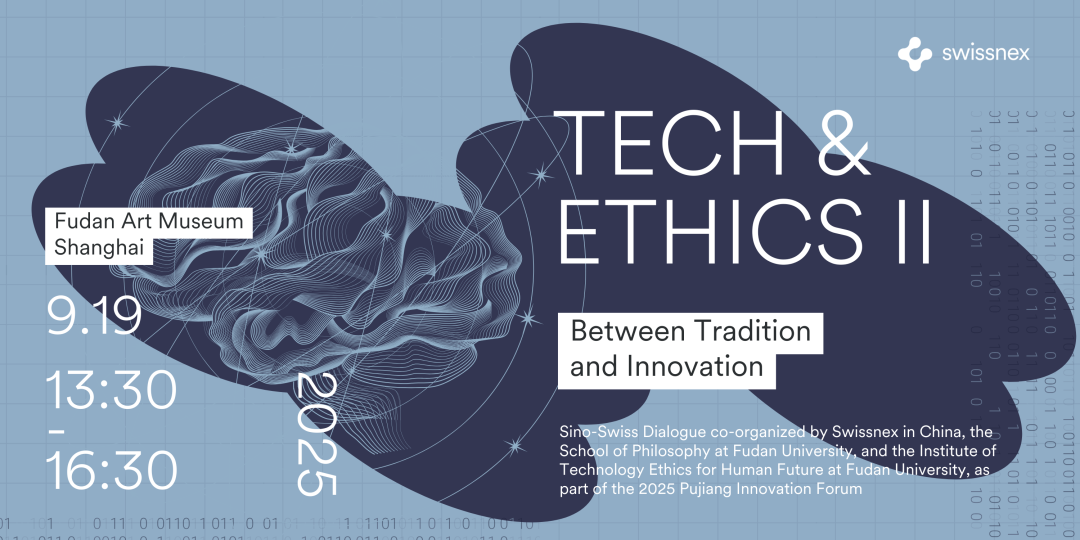
The event is organized under the framework of the 2025 Pujiang Innovation Forum, co-hosted by the Swissnex in China, the School of Philosophy, Fudan University, and the Institute of Technology and Ethics for Human Future at Fudan University.
Event Details
Date: September 19, 2025
Time: 13:30 – 16:30
Venue: Fudan University Art Museum (Fudan Yuan, 220 Handan Road, Yangpu District, Shanghai)
Language: English (Simultaneous interpretation provided)
Program Schedule
13:15 – 13:30 Registration
13:30 – 13:45 Opening Remarks
Prof. Wang Guoyu, Professor at the School of Philosophy, Fudan University, and Dean of the Institute of Technology Ethics for Human Future at Fudan University
Raphaela Oliver, CEO of Swissnex in China, Consul
13:45 – 15:15 Keynote Speeches
Dr. Pang Cong, Department of Philosophy, Shanghai University
“Informed Consent in the Era of Precision Medicine: Away from Autonomy, Toward Trust?” 《精准医学时代的知情同意:远离自主,走向信任?》Dr. Sara Kijewski, Health Ethics & Politics Lab, ETH Zurich
“AI in Precision Medicine: Reflection Pathways on Innovation and Public Trust” 《人工智能在精准医疗中的应用:创新与公众信任的反思路径》Dr. Yang Yu, Institute of Technology Ethics for Human Future at Fudan University
“Identity and the Self in Brain-Computer Interface(BCI) Practices: An Interdisciplinary Analysis” 《脑机接口临床实践中的个人同一性变化:基于跨学科视角的分析》
Michael Conrad, Swiss Design and Health Center
“Embedding Ethics in AI Research to Safeguard Patient Safety” 《将伦理融入人工智能研究以保障患者安全》
Dr. Xu Hanhui, Institute of Technology Ethics for Human Future at Fudan University
“Evaluating Reproductive Ethics of Large Language Models: Insights from Chinese Ethical Norms” 《大语言模型生殖伦理评测--基于中国伦理规范》
Dr. Jonathan Andrew, Geneva Academy of International Humanitarian Law and Human Rights
“Protecting Vulnerable Groups in Neurotechnology: The Role of Patient Advocacy and International Cooperation” 《保护神经技术中的弱势群体:患者倡导与国际合作的角色》
15:30 – 16:15 Roundtable Discussion
Theme: Tradition Meets Innovation: Ethical Pathways for the Future of Life Sciences 生命科学未来的伦理路径
Moderator:
Dr. Zhu Linfan, Associate Researcher at the Institute of Technology and Ethics for Human Future at Fudan University
Panelists:
Václav Pechtor, Researcher in Artificial Intelligence and Data Engineering, School of Management and Law, Zurich University of Applied Sciences (ZHAW)
Wang Yijie, Postdoctoral researcher at the Institute of Technology and Ethics for Human Future at Fudan University
Ding Guohui, Executive Director at the Institute of Digital Health of Shanghai International Human Phenome Consortium
Xu Weijing, Assistant Professor of Media and Arts, Duke Kunshan University
Alix Wasilenko, Researcher at Medical School of University Zurich / Zurich Kinderspital
16:15 – 16:30 Audience Q&A & Summary
Yin Jie, Professor at School of Philosophy, Fudan University, Vice Dean of the Institute of Technology and Ethics for Human Future at Fudan University
Keynote Speakers
Pang Cong

Assistant Professor at the Department of Philosophy, Shanghai University; member of the Center for Marxist Studies of Science, Technology, and Society (STS).
Her courses include Applied Ethics, Philosophical Methodology, Introduction to Dialectics of Nature, and Fundamentals of Marxism.
Her research focuses on the ethics of precision medicine, informed consent, and theories of autonomy.
She holds a Ph.D. in Philosophy from Fudan University, a BS. in Public Health from Sichuan University, and an MS. from the Chinese Center for Disease Control and Prevention.
Dr. Sara Kijewski

AI Ethics & Policy Network COO of ETH Zurich. Researcher at the Health Ethics & Politics Lab, ETH Zurich. Her research centers on AI governance, responsible innovationand digital health, with particular expertise in practical governance tools for AI and the ethical dimensions of AI in healthcare.
She holds a Ph.D. in Political Science from the University of Bern.
Her work addresses AI governance frameworks, decentralized clinical trials, and ethical issues in medical AI, including personalized medicine and clinical decision support systems.
Dr. Yang Yu

Researcher, Institute of Technology and Ethics for Human Future at Fudan University
Her work focuses on the philosophy of cognitive science and technology ethics, especially ethical challenges posed by brain–machine interface (BCI) technologies.
She earned her Ph.D. in Philosophy of Science and Technology from Beijing Normal University and was selected for both the “Super Postdoctoral Program” at Fudan University and the Shanghai Municipal “Super Postdoctoral Program.”
Michael Conrad

Data Scientist, Swiss Center for Design and Health (SCDH).
He leads the forward-looking development of digital capabilities in the SCDH Living Lab, including motion capture and sensor technologies.
With extensive experience in designing and delivering deep learning solutions across technical and managerial roles, he bridges the gap between technical feasibility and business value.
His professional ethos is: listen first, build trust, and deliver truly viable solutions.
Dr. Xu Hanhui

Research Fellow, Institute for Technology and Ethics for Human Future, Fudan University.
His research interests include clinical ethics, nursing ethics, and the ethics of medical AI.
Current projects involve ethical studies on smart devices in elderly care, ethical evaluation of large language models in medicine, Comprehensive Assessment of Jailbreak Attacks Against LLMs in medical contexts, and the ethical boundaries of machine empathy.
Dr. Jonathan Andrew

Expert in human rights and data protection law with a multidisciplinary background in international law, development economics, business management, information technology, and bioethics.As a researcher at the Geneva Academy of International Humanitarian Law and Human Rights, his research examines the human rights implications of neurotechnology and supports deliberations of UN member states through collaboration with the UN Human Rights Council and its advisory bodies.He is also an International Visiting Scholar at the Pufendorf Institute and Department of Medical Ethics, Lund University, Sweden, and serves as ethics mentor for the EU “COMBAT Dengue” project at the Karolinska Institute.He sits on two European Commission ethics advisory boards overseeing emerging technologies in privacy, data protection, and fundamental rights.
Dr. Andrew has extensive experience in the special procedures of the Office of the United Nations High Commissioner for Human Rights, having served as a senior advisor assisting six mandates/special rapporteurs. Currently, he acts as an advisor to the UN Special Rapporteur on the promotion and protection of human rights and fundamental freedoms while countering terrorism, researching the impact of artificial intelligence in counter-terrorism operations. He has authored and contributed to numerous publications for UN agencies (including OHCHR, IOM, UNCTAD, UNICEF), international NGOs (such as ICNL), and the European Commission/European Parliament, covering a wide range of international law and human rights issues.
Roundtable Participants
Dr. Zhu Linfan

Associate Research Fellow, Institute for Technology and Ethics for Human Future, Fudan University.
He holds a Ph.D. in Philosophy from Peking University, and his research interests include AI ethics, experimental ethics, philosophy of cognitive science and psychology, and social epistemology related to science and law.
He previously studied at Shanxi University and the University of Copenhagen, and has conducted research visits at York University (Canada) and the University of Stirling (UK).
Václav Pechtor

AI and Data Engineering Researcher, School of Management and Law, Zurich University of Applied Sciences (ZHAW).
Ph.D. candidate specializing in the application and impact assessment of AI — including large language models and intelligent agent systems — in public administration and public health.
His methodological expertise lies in causal inference for robust policy and program evaluation.
With extensive leadership experience in technology and data projects, he works to integrate frontier AI research with real-world governance challenges.
Dr. Wang Yijie

Postdoctoral Fellow, Institute forTechnology and Ethics Human Future, Fudan University.
Ph.D. in Philosophy from Goethe University Frankfurt.
Her research focuses on applied ethics and political philosophy, especially bioethics, medical ethics, health justice, and global justice.
She has published in Medicine, Health Care and Philosophy, the official journal of the European Society for Philosophy of Medicine and Healthcare (ESPMH).
Dr. Ding Guohui

Executive Director, Institute of Digital Health, Shanghai International Institute of Phenome Science & Technology.
His research interests include biomedical informatics, biomedical data security and trusted sharing, and holistic health.
He is currently leading the design of next-generation biomedical data infrastructures and contributes to the development of standards in biomedical data and bio-digital convergence.
Dr. Xu Weijing

Interdisciplinary artist and researcher; Assistant Professor of Media and Arts, Duke Kunshan University.
Her creative practice explores the intersections of biology, material ecology, technology, and cybernetics.
She co-directs the Design, Technology, and Radical Media Lab (DTRM) and co-chairs the Art, Media, and Cybernetics Working Group under the American Society for Cybernetics.
Dr. Alix Wasilenko

Physician and doctoral candidate from Germany.
Graduated in Medicine from the Albert-Ludwigs-Universität Freiburg in 2022 and earned her doctoral degree in 2023.
Recently completed an M.P.H. at Harvard University, focusing on research design and quantitative methods in biostatistics, bioinformatics, and biomedical sciences.
Currently, Research Fellow at the University of Zurich Medical Faculty and University Children’s Hospital Zurich.
Her research focuses on novel gene therapy approaches for rare diseases, responsible innovation in clinical translation, and ethical frameworks for public and global health at the WHO Collaborating Centre for Bioethics in Zurich.
She also lectures at ETH Zurich and the University of Zurich Medical Faculty.
Cooperators: